Table of Content

Blackjack Online: Rules, Strategy, Demo and Real Money Play

Written by the editorial team at casiny-official-au.com. Fact-checked by Claire Bennett, Senior iGaming Content Editor. Last updated: July 2026

"Before assessing the visual appeal of any online casino table, check the rules and the underlying mathematics. The difference between a 3:2 and 6:5 payout ratio matters far more than an attractive interface." — Claire Bennett, Senior iGaming Content Editor

Quick Summary for New Players

RTP

99.43%

Volatility

Low

Min bet

$1

Blackjack Online Rules, Strategy, Demo and
  • Goal:Beat the dealer's hand without exceeding 21. Number cards are face value, face cards equal 10, and an Ace counts as 1 or 11.
  • Is it legal in Australia?The Interactive Gambling Act 2001 prohibits Australian-licensed operators from offering online casino games. Players who access offshore sites do so outside local consumer protections.
  • House edge:With perfect basic strategy, roughly 0.5%. Without it, 2 to 5%.
  • Bonuses:Blackjack typically contributes only 5 to 10% towards wagering requirements. Read the fine print.
  • Best format for beginners:Start with free demo play to learn mechanics, then consider low-stakes tables if you choose to play for real money.
  • Responsible play:Set strict time and loss limits. If gambling stops being entertainment, contact Gambling Help Online at 1800 858 858 or visit gamblinghelponline.org.au.
Casiny heading-banner

What blackjack is and how online blackjack works

Blackjack is a casino card game where you compete against the dealer to build a hand total closer to 21 without going over. Whether played at a physical table or on a screen, the core mechanics rely on probabilities, risk assessment, and knowing when to take another card. In the online blackjack space, the format generally splits into two categories: automated RNG games and live dealer broadcasts.

Worth noting: the online blackjack landscape has shifted heavily towards human interaction over the past few years. By mid-2026, live dealer games are projected to account for roughly 31 per cent of all online casino revenue, with the global live casino market growing at a compound annual growth rate of approximately 14.2 per cent. The average stake in live blackjack sits at around $22.50, nearly 2.6 times the $8.75 typical of standard digital tables. Mobile live blackjack sessions alone grew 43 per cent between 2023 and 2025, with average session duration reaching 47 minutes. The number of licensed live dealer studios worldwide climbed from 87 in 2020 to over 200 by 2025, reflecting how quickly the format has matured.

What blackjack is and how online

Editor's note: Earlier versions of this section cited a specific figure of "68 per cent of online players preferring live dealers" and a "$2.1 billion" market size. These statistics originated from internal industry briefings without a publicly verifiable methodology or sample size. We have replaced them with broader trend data consistent with multiple industry reports. When publicly audited figures become available, we will update accordingly.

So how does a digital blackjack game actually work under the hood? In automated modules, a Cryptographically Secure Pseudorandom Number Generator (CSPRNG) captures a unique seed number tied to the precise millisecond you click "deal." The server translates this into specific cards, preventing client-side manipulation. In live dealer blackjack, no RNG is involved in card delivery at all. Physical cards are drawn from a real shoe, and fairness is maintained through Optical Character Recognition scanning and independent shuffle audits.

Blackjack card values

Before diving into rules and strategy, you need to know what every card is worth. This is genuinely the most fundamental piece of knowledge in the game.

CardValue
2 to 10Face value (a 7 is worth 7, etc.)
Jack, Queen, King10 each
Ace1 or 11, whichever benefits the hand

Hard vs Soft hands: A hand containing an Ace counted as 11 is called a "soft" hand (for example, Ace + 6 = soft 17) because it cannot bust with one additional card. Once the Ace must be counted as 1 to avoid exceeding 21, the hand becomes "hard." This distinction matters more than most beginners realise, because it changes your optimal decision on almost every play.

Key blackjack terms

Below is a glossary designed to clarify essential concepts before you move on to detailed table mechanics.
  • Dealer:The casino representative or automated algorithm that deals cards and plays according to strictly fixed rules, with no discretionary choices.
  • Table:The virtual interface or physical felt displaying betting boxes, dealt cards, chip stacks, and established minimum or maximum limits.
  • Bet:The specific amount of funds or virtual credits a player stakes on the outcome of a single hand.
  • Hit:A decision to request one additional card in an attempt to improve the hand total towards 21.
  • Stand:A decision to take no further cards, retaining the current hand total and passing the turn to the house.
  • Split:An action that divides an initial matching pair into two separate hands, requiring an additional wager equal to the original.
  • Double Down:A choice to double the initial bet in exchange for receiving exactly one additional card before automatically standing.
  • Surrender:An option (where available) to forfeit half the bet and end the hand immediately rather than playing it out against a strong dealer upcard.
  • Live dealer:A real human operator streamed via high-definition video who conducts the physical blackjack session in real time.
  • Push:A tie. The player and dealer finish with the same total; the original bet is returned with no profit or loss.
Key blackjack terms. Below is a

RNG blackjack game vs live dealer blackjack

The primary difference between a Random Number Generator (RNG) blackjack game and a live dealer blackjack session comes down to three things: how card outcomes are determined, the pacing, and the overall atmosphere. Automated titles use algorithmic software to instantly determine the outcome of a shoe, processing actions without delay. Live online blackjack, by contrast, involves physical playing cards removed from a mechanical shoe by human hands.

This difference in delivery deeply affects player engagement. Industry analyses indicate that the retention rate for live dealer blackjack is considerably higher than for standard RNG alternatives, driven largely by interpersonal trust and the visible real blackjack experience. Surveys consistently show that over 70 per cent of live dealer participants report significantly greater confidence in the fairness of outcomes compared to purely algorithmic games, largely because they can watch every card drawn in real time. Average session bets at live tables run between 30 and 40 per cent higher than standard automated lobbies.

The speed also diverges heavily. Automated formats handle between 180 and 240 rounds per hour, while broadcast physical tables manage only 50 to 70 hands in the same timeframe. As a result, the average player session in live blackjack games frequently reaches 36 minutes, roughly double the duration of a purely digital engagement.

RNG blackjack game vs live dealer

What players see at blackjack tables online

Online blackjack tables present players with a clean user interface containing dynamic betting options, chip selectors, and visible table limits overlaid onto the active screen. Software designers build these environments to replicate land-based layouts while tucking complicated betting histories behind collapsible menus.

When you play blackjack online, action buttons adapt dynamically to the state of the hand. For example, the option to split only appears if your initial two cards carry the same value. Dealer blackjack limits are clearly listed near the top of the interface, displaying both the minimum required wager to join and the maximum stake permitted for an individual hand. Rather than blocking the primary visual feed, this overlay interface keeps critical functions accessible whether you are using a large desktop display or a smaller mobile device screen. It is a small detail, but it makes a real difference to the flow of play.

What players see at blackjack tables

Blackjack rules every player should know

The foundational blackjack rules are straightforward: build a card total higher than the dealer's hand without going over 21. Navigating this structure requires a methodical approach to evaluating your starting hand, watching the dealer's visible card, and making statistically informed decisions.

In a standard sequence, bets are placed before any cards are distributed. The dealer typically provides two face-up cards to the player, while keeping one face-down card and one visible card for the house. The player then reviews their combination and opts for a hit, stand, double, or split. If the player exceeds 21, the hand busts and the wager is automatically forfeited. Once all participants at the table finalise their choices, the house reveals the hidden card and resolves the round based on mandatory rules.

Blackjack rules every player should know
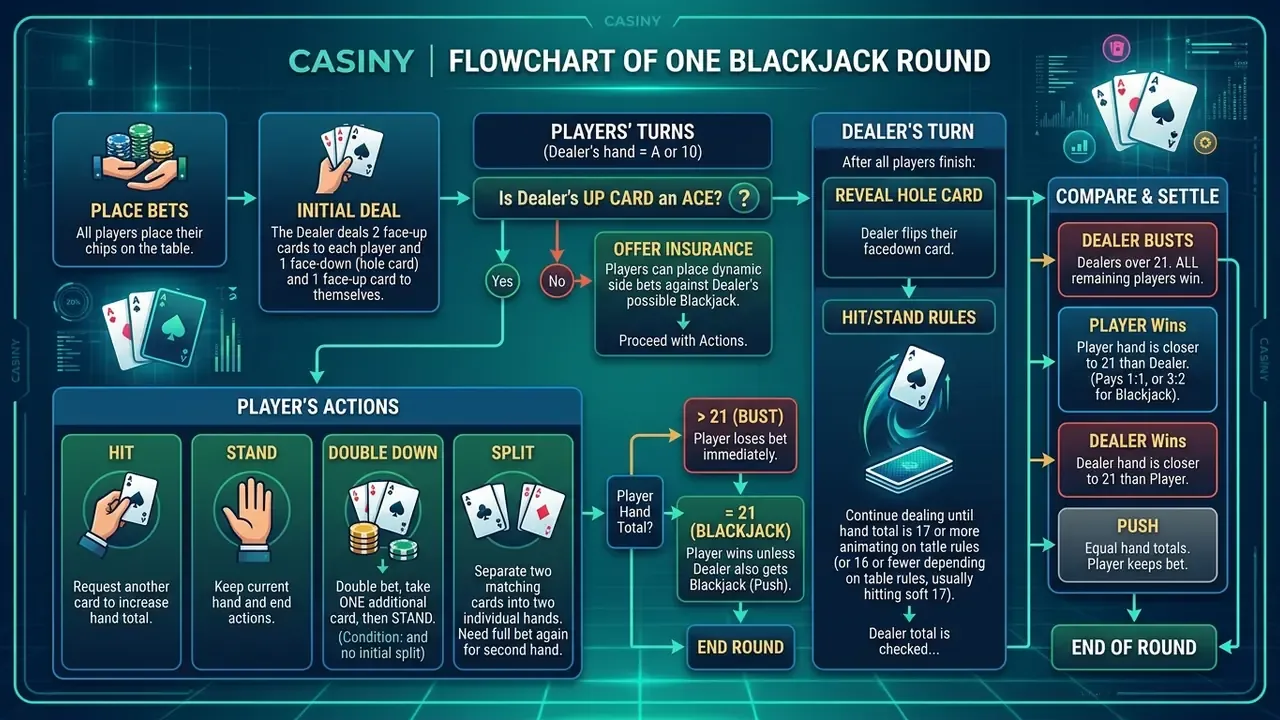
Step-by-step process of a game round

Textual breakdown of the flowchart steps:

  1. Initial Wager: Players place their preferred bet within the designated table parameters.
  2. The Deal: The player receives two face-up cards. The house assigns itself one visible and one hidden card.
  3. Blackjack Check: If either the player or dealer holds a natural blackjack (Ace + 10-value card), the round may resolve immediately.
  4. Player Decision: Based on the current total, the player chooses to hit, stand, double down, split, or surrender (where available).
  5. Bust Check: If the cumulative value surpasses 21, the player loses the round immediately.
  6. Dealer Action: The house acts upon strict constraints, usually hitting until reaching a minimum of 17.
  7. Comparison: Final totals are compared.
  8. Resolution: Wins are paid out (1:1 for regular wins, 3:2 for a natural blackjack), ties return the stake (push), and losses are collected.
Textual breakdown of the flowchart steps

Core decisions: hit, stand, double and split

Every blackjack round forces you to choose between hit, stand, double, or split. These decisions mathematically define your overall potential for success. Taking a hit introduces a new card to improve your hand but escalates the risk of busting. Standing holds your current total, passing that value directly against whatever the dealer ultimately produces.

Basic strategy highlights some definitive initial decisions. For instance, players are statistically recommended to double down when holding an 11, maximising value against most dealer upcards. It is also mathematically advised to always split Aces and 8s, breaking poor starting hands into stronger distinct positions. By contrast, a well-established rule says you should never split tens or fives, as it destroys heavily advantageous totals. Mastering these tactical choices shapes the mathematical realities of playing blackjack over the long term.

Core decisions hit, stand, double and

Dealer rules, payouts and side bets

The dealer operates under rigid, non-discretionary casino rules that directly impact the house edge and standard payout expectations. The dealer is required to draw more cards until hitting a hard minimum of 17, at which point standing becomes mandatory.

When observing common live blackjack features, understand that standard regular wins pay 1:1, returning your initial bet plus an identical profit margin. A natural "blackjack" (an Ace combined with a 10-value card) regularly yields 3:2 payouts across traditional tables, statistically occurring roughly once every 21 hands in a multi-deck game. However, players must verify this metric. Some lower-tier offerings compress this down to 6:5, causing severe structural disadvantages. Switching from a 3:2 to a 6:5 blackjack payout reduces RTP by approximately 1.4 percentage points, which significantly increases the casino's edge over time.

Side bets further alter the mathematics. Betting on Perfect Pairs (with a house edge of 4 to 11% depending on deck count and pay table) or the 21+3 integration (house edge from 3.7% up to 13.4%) can provide higher possible outcomes but pushes the standard 0.5 per cent house edge drastically upward. In some configurations, the casino advantage climbs beyond 13 per cent depending on the deck count and specific pay table. That is a steep price for a side bet thrill.

Dealer rules, payouts and side bets

How to play blackjack online for free or real money

Choosing whether to play a blackjack demo or engage in real money blackjack depends on your familiarity with local laws, your personal budget discipline, and your understanding of the mathematics. Both modes use the same operational frameworks, yet the consequences of your decisions separate purely educational sessions from explicit financial risk.

In Australia, the Interactive Gambling Act 2001 (IGA) regulates the digital environment heavily. The Act explicitly classifies online blackjack as a prohibited interactive gambling service, preventing Australian-licensed operators from offering it. While local frameworks primarily target the operators, this legislation has encouraged players to explore free play blackjack concepts on accessible social applications. Selecting an offshore real money pathway involves accepting environments devoid of Australian consumer protection guardrails.

📋 Legal Disclaimer
This information is general in nature and does not constitute legal advice. For clarification on the legal status of online gambling in your jurisdiction, consult a qualified legal professional. Laws vary by state and territory, and enforcement approaches change over time.

How to play blackjack online for

When blackjack demo is enough

A blackjack demo is an optimal, entirely safe tool for testing mathematical strategies and interface pacing without any exposure to monetary risk. Reliable operators match their demonstration products precisely with their live configurations, so players can execute strategy testing on virtual currency with confidence. According to ACMA guidance, social casinos offer games like blackjack using virtual currency with no ability to withdraw winnings. They are regulated as video games rather than gambling products.

If you are in a restricted region, social casino platforms such as BetRivers.net or Rush Games offer live-format blackjack using virtual sweepstakes coins, allowing you to experience live dealer interfaces without real money risk.

Here is a practical approach: experienced players frequently run 100-hand trial sets using a demo platform. This methodology allows you to measure session volatility or explore hitting on soft 17 structures without losing capital. However, public health research raises important warnings about the bridge between simulated and real gambling. One study found that lifetime participation in simulated gambling was associated with real-money wagering and higher scores on the Problem Gambling Severity Index (PGSI).

When blackjack demo is enough. A

"Adolescents who had played social casino games in the past month were approximately 2.5 times more likely to meet criteria for gambling disorder compared to those who had not." - Adolescent simulated gambling and gambling disorder research, 2023.

Approaching demo blackjack primarily for mechanical familiarity, rather than as a reliable indication of future cash performance, helps maintain a healthier perspective.

ℹ️ Information Notice
This information is general in nature and does not replace consultation with a specialist on addiction issues or a legal adviser. If you or someone you know is experiencing gambling harm, contact Gambling Help Online at 1800 858 858 or visit gamblinghelponline.org.au.

What changes in real money blackjack

Transitioning to real money blackjack completely modifies player psychology. Genuine financial consequences alter the speed and scale of decision-making. Experiencing actual money blackjack naturally shifts your mindset from analytical learning into an environment where emotional chasing frequently appears.

Research into within-session chasing behaviour found that players tend to increase their bet sizes and extend sessions immediately following losses, while they tend to reduce play after sustained cumulative losses. The psychological dynamics behind table limits and individual banking expectations become significantly more stressful. A simple bad streak can rapidly provoke flawed decisions, encouraging you to reject established basic strategy. I have seen this pattern described in study after study, and it is remarkably consistent.

What changes in real money blackjack

"Research on within-session chasing at online casinos found that players increased bets and extended sessions after immediate losses, but curtailed play after cumulative losses." - Experimental study of within-session chasing in online casinos, 2023.

⚠️ Editor's Caution: Financial Risks and Legal Checks
Real money blackjack explicitly involves long-term financial costs and possible addiction risks. Be acutely aware that the Interactive Gambling Act 2001 strictly prohibits Australian-licensed businesses from operating digital casinos. If you access offshore blackjack casino brands, check current terms, withdrawal restrictions, and your local jurisdiction's laws before depositing. Always set strict time and budget limits prior to opening a table.

Australian support resources:
• Gambling Help Online: gamblinghelponline.org.au | 1800 858 858
• Self-exclusion tools: BetStop National Self-Exclusion Register - betstop.gov.au

Live blackjack and live dealer formats

Live dealer blackjack broadcasts a human operator managing physical cards through an advanced, high-definition streaming setup, merging the reliability of physical action with digital convenience. This format has successfully reshaped industry standards, delivering a slower, considerably more authentic pacing model than automated alternatives.

Modern studios use highly sophisticated infrastructure to stream the dealer blackjack experience. The tables are configured with advanced Optical Character Recognition (OCR) technology that instantly scans physical cards as they slide out of the shoe, digitally reflecting their value on your screen overlay. The video transmission generally runs at 60 frames per second, requiring bitrates anywhere from 4 Mbps for 1080p up to 8 Mbps for 4K. As of 2026, no major live casino studio has deployed augmented reality (AR) in production blackjack streams. The technology remains in the development pipeline.

Live blackjack and live dealer formats

Why players choose live online blackjack

Players primarily migrate toward live online blackjack to interact within an atmosphere of pronounced visual transparency that purely automated mathematics often fail to provide. Watching a tangible person shuffle and distribute cards creates a profound emotional trust factor. It just feels different.

Industry survey data consistently indicates that over 70 per cent of live dealer players report significantly more confidence in random outcomes generated by live dealer blackjack than they do with an RNG substitute. The real blackjack atmosphere removes the lingering suspicion that software code acts in a biased manner. Due to this heightened immersion and social validation, average participation metrics demonstrate that session bets at live locations run between 30 and 40 per cent higher than standard automated lobbies.

However, players should be aware that this heightened engagement carries its own risks. Research into iGaming product types has found that live dealer games demonstrate significantly higher correlation with markers of problem gambling risk than their RNG counterparts. The combination of longer sessions, larger average bets, and social validation can accelerate harmful patterns without players recognising the shift.

ℹ️ Responsible Play Reminder
This information is general in nature and does not replace professional advice. Online gambling carries financial risks. Set session time limits and loss caps before joining any live table. If you feel your play is no longer entertaining, step away and seek support.

Why players choose live online blackjack

Common live blackjack games and table options

Standard live blackjack frequently features classic configurations capping seats at seven individuals per table, whereas modern infinite variations handle thousands of users on a single dealt rotation. The structural diversity of blackjack tables gives you real flexibility regarding risk.
  • Infinite Blackjack -Evolution's highly popular live variant processes a single set of dealer actions for a limitless audience. It uses eight physical decks and uniquely incorporates the Six Card Charlie mechanic, a rule promising an automatic reward if a player accumulates six cards without breaking 21, irrespective of what the dealer possesses. Four optional side bets are available: Any Pair, 21+3, Hot 3, and Bust It (where the maximum payout reaches 250:1 if the dealer busts with six or more cards).
  • Lightning Blackjack -Classic blackjack electrified with RNG-based Lightning Card multipliers (2x to 25x) in every game round. Players pay a 100% Lightning fee on every initial bet, and a winning hand is always guaranteed a multiplier to be applied in the next round. The volatility is notably higher than standard blackjack.
  • Free Bet Blackjack -Players receive a free double down on two-card hard totals of 9, 10, or 11, plus free split bets on all pairs except 10-value cards. The free bets are automatically offered whenever a qualifying hand appears. Available in both seven-seat and infinite formats.
  • Power Blackjack -An infinite-seat format played with eight decks where all 9s and 10s have been removed (picture cards remain). Players can double, triple, or quadruple down on any two initial cards, even after a split.
  • Bet Behind -A feature available on most seven-seat tables allowing spectators or waiting players to place bets behind seated players. This is a popular way for new players to observe and learn while still participating in the action, though it carries the same risk as direct play.
Common live blackjack games and table

Standard live blackjack games typically omit fringe mechanics like Six Card Charlie, sticking to purist layouts and rigid side bet models.

Format differences: Automated vs Live Dealers

Comparison of RNG Blackjack and Live Dealer Blackjack Mechanics

DimensionRNG Blackjack TableLive Dealer Blackjack Format
Game TempoAggressive pace running at roughly 180 to 240 distinct hands hourly.Moderate human-driven pace processing around 50 to 70 hands hourly.
General AtmosphereEntirely simulated environment operating without human visual cues.Real video streams displaying actual human dealers and physical equipment.
Player InteractionZero chat features. Fully isolating user experience.Real-time messaging available between dealers and active participants.
Typical SessionUsually averages around a brief 18-minute engagement.Longer sustained interaction typically stretching to 36 minutes.
Card FairnessCSPRNG algorithm audited by eCOGRA/GLI/iTech Labs.Physical cards + OCR scanning, independently audited shuffle procedures.
Internet RequirementStable connection for instant data transfer; low bandwidth sufficient.Minimum 4 Mbps for 1080p stream; 8 Mbps recommended for 4K.

Interpreting these metrics makes the divide clear: RNG versions cater perfectly to rapid strategy repetition in shorter bursts. The social infrastructure of the live table, on the other hand, commands attention for substantially larger blocks of time. Which suits you better depends on what you are actually looking for.

Blackjack strategy basics for better decisions

Blackjack strategy is rooted in mathematical evaluation built to suppress the structural house edge derived from the dealer acting last. Rather than relying on gut instinct, strategy demands repeating mathematically optimal routines for every specific combination of cards.

By applying computer simulations over millions of hands, analysts map the expected value (EV) for every move. When optimal player decisions cross with generous internal rules, the inherent casino advantage drops to roughly 0.5 per cent. In a single-deck game with player-favourable rules, the edge can dip as low as 0.3 per cent. Achieving this benchmark, though, requires completely stripping out emotive, reactive modifications and sticking firmly to hard statistical recommendations. Easier said than done at the table.

Blackjack strategy basics for better decisions

Basic strategy and common mistakes

Basic strategy serves as a comprehensive mathematical chart advising players exactly when to execute decisions based on their hand value relative to the dealer's visible card. While these rules seem rigid, deviating from them is a common source of unnecessary losses.

Basic Strategy Quick-Reference (Cheat Sheet):

Your HandDealer Shows 2 to 6Dealer Shows 7 to Ace
Hard 8 or lessHitHit
Hard 9Double (vs 3 to 6); otherwise HitHit
Hard 10Double (vs 2 to 9)Hit
Hard 11DoubleDouble (except vs Ace, Hit)
Hard 12Stand (vs 4 to 6); Hit vs 2 to 3Hit
Hard 13 to 16StandHit
Hard 17+StandStand
Soft 13 to 15Double (vs 5 to 6); otherwise HitHit
Soft 16 to 18Double (vs specific low cards); otherwise Hit or StandHit (soft 16 to 17); Stand (soft 18 vs 7 to 8)
Soft 19+StandStand
Pair of A/8Split alwaysSplit always
Pair of 10/5Never splitNever split
Pair of 2/3/7Split (vs 2 to 7)Hit
Pair of 6Split (vs 2 to 6)Hit
Pair of 9Split (vs 2 to 6, 8 to 9)Stand vs 7; Hit vs 10/A
Pair of 4Split (vs 5 to 6)Hit

Save this table to your phone for reference during demo sessions.

Players frequently destroy their win potential through fundamental errors. One extremely common mistake involves deciding to hit on a hard 12 when you see the dealer holding a 4, 5, or 6. Mathematical models clarify that standing is superior in this instance because it passes the bust variable directly to the house. Other significant tactical failures include remaining cautious on an 11 instead of executing a double down, or refusing to split a pair of 8s out of misplaced fear. Each misstep nudges the house edge systematically upward, penalising a disorganised playing style over time.

Common costly errors at a glance:

  • Hitting hard 12 against dealer 4 to 6 (correct: stand, as the dealer is more likely to bust)
  • Not doubling on 11 against dealer 2 to 10
  • Refusing to split 8s or Aces
  • Splitting 10s (breaking a strong 20)
  • Taking insurance (a side bet carrying roughly a 7% house edge)
Save this table to your phone

How strategy changes in live and online games

Executing a reliable methodology changes when you evaluate the differences between online blackjack and physical locations, mostly due to shuffling speed mechanics. Card counting tactics practically evaporate when crossing into digital channels.

In live blackjack digital lobbies, operators traditionally configure shoes encompassing six to eight full decks. The deck penetration, meaning the percentage of cards dealt out before fresh shuffling occurs, rarely exceeds 50 per cent. This sharply limits the data available for tracking. Furthermore, automated RNG software continuously reshuffles the moment a digital round resolves. In RNG blackjack, the continuous reshuffling after every hand makes traditional card counting entirely impractical, leaving basic strategy as the only reliable tool.

Because players completely lose the ability to establish a reliable running true count, betting rhythm adjustments become highly speculative and fundamentally useless outside of pure basic strategy applications. Put simply: learn the chart, trust the chart.

How strategy changes in live and

Blackjack game variants you can play online

Online casino spaces leverage software versatility to present numerous blackjack game variants, subtly adjusting rulesets regarding deck volume and doubling conditions. The variety ensures a format appropriately matching individual risk profiles and playing preferences.

Navigating online portals inevitably surfaces prominent titles like Vegas Strip, Atlantic City, and Blackjack Switch. Unique variants like Spanish 21 controversially eliminate all physical 10s from the playing shoes entirely while attempting to compensate through generous additional promotions such as special bonus payouts for 7-7-7 combinations. Understanding how one blackjack game modifies the internal logic completely dictates whether a player should stay or step away to find fairer odds.

Blackjack game variants you can play

Classic and European blackjack

The critical distinction separating blackjack classic American formats from European iterations is the timing of how the dealer checks the hidden card for a natural win. This simple variation profoundly alters strategy mapping and possible monetary exposure.

In a Classic presentation, the dealer receives one visible card and an attached face-down secondary card. If showing an Ace or 10, they instantly verify the hidden card and claim a victory if a blackjack registers, ending the round before players double their funds. European variants use a rigid "No Hole Card" structure. Here, the house pulls precisely one physical card, drawing the second only after participants finalise every option. Consequently, playing European tables involves greater risk because players might unnecessarily split hands and boost wagers before abruptly discovering the dealer holds an unbeatable combination.

That is a subtle but expensive difference if you are not paying attention.

Classic and European blackjack. The critical

Infinite, speed and side-bet versions

Feature-driven iterations like infinite blackjack drastically change round limitations by accommodating unlimited traffic on identical core hands, frequently combining this open access with aggressive side-bet models. This completely replaces standard player limits.

Speed arrangements automatically enforce strict time limits on player decisions, issuing a standing choice if a participant hesitates too long. Additionally, side bets like Perfect Pairs or the complex 21+3 framework are prominent inside infinite tables. While these optional bets sporadically trigger massive payout variations reaching upwards of 100:1 (for suited trips in 21+3), their statistical probability carries harsh mathematical advantages serving the casino operators, with house edges frequently climbing to 4 to 13% or more depending on deck count and payout structure.

Infinite, speed and side-bet versions. Feature-driven

Other notable variants

  • Blackjack Switch:Requires two hands per player, with the unique ability to swap the top card between them after the initial deal. Strategy shifts significantly because you are optimising across two hands simultaneously.
  • Double Exposure Blackjack:Both dealer cards are dealt face-up, dramatically changing strategy but with adjusted payout rules to compensate for the transparency.
  • Pontoon:Popular in the UK and Australia, using distinct terminology (Pontoon = natural, Twist = hit, Stick = stand) with both dealer cards face-down. The different naming conventions can trip up players used to standard blackjack terminology.
Other notable variants

How to choose a blackjack casino or site

Selecting a dependable blackjack casino involves a rigorous checklist evaluating technical safety, transparent company documentation, compliance frameworks, and reliable banking tools. Never register solely on the strength of an aggressive welcome banner.

For the Australian market, verify internal regulatory realities firmly restricting domestic interactions. A responsible overview checks if the best online blackjack hubs hold global licences from jurisdictions like the MGA or the UKGC. Active SSL network protection remains absolutely mandatory to secure transactions. To avoid hidden complications, review their approach to responsible gambling tools such as loss limits, and observe the independent channels they maintain for managing active financial complaints.

Safety checklist - 5 criteria before you register:

  1. Active licence from a recognised regulator (MGA, UKGC, NJDGE). Verify the licence number directly in the regulator's public database.

  2. SSL encryption. Look for HTTPS with the padlock icon in your browser's address bar.

  3. RNG certification from an independent laboratory (eCOGRA, GLI, iTech Labs) with published or verifiable RTP figures.

  4. Transparent banking. Support for familiar payment methods with clearly stated withdrawal timeframes and no hidden fees.

  5. Dispute resolution. An independent Alternative Dispute Resolution (ADR) body listed on the site and responsive 24/7 customer support.

Red flags to watch for at offshore sites:

  • No verifiable licence number or a licence from an unrecognised jurisdiction
  • No KYC (Know Your Customer) verification before allowing deposits
  • Hidden withdrawal fees or unexplained "processing" delays
  • Blackjack contribution of 0% towards bonus wagering (meaning the bonus is unusable at the tables)
  • No visible responsible gambling tools (deposit limits, session timers, self-exclusion options)

Game variety, limits and mobile play

A high-quality blackjack site consistently offers wide game variety accommodating modest budgets alongside high-tier tables, complemented by reliable mobile architecture. Being able to play smoothly on a phone is essentially a baseline requirement for modern operators.

You should readily locate blackjack tables accommodating bets between typical $5 thresholds scaling smoothly up towards higher stakes. Land-based comparisons are stark: Crown Melbourne's minimum sits at $10 to $25 per hand, whereas online platforms routinely start at $1 or less. Rather than demanding complex executable downloads, premium platforms manage transitions natively through browser frameworks via sophisticated HTML5 formatting. Robust integrations pair directly with system mechanisms such as Google Play Games Services, generating seamless, interruption-free environment continuity as participants transition from desktop interfaces onto mobile blackjack screens.

Game variety, limits and mobile play

Bonuses, banking methods and speed

Welcome promotions demand detailed scrutiny before any registration happens, as underlying wagering conditions routinely penalise table games significantly to protect institutional profits. Understanding bonus structures completely protects players from unintentionally locking liquidity away.

Wagering requirement example for blackjack players:

Consider a $100 welcome bonus with 30x wagering and a 5% blackjack contribution rate. In slot games (typically 100% contribution), you would need to wager $3,000 total ($100 x 30). In blackjack, at only 5% contribution, each $1 bet contributes only $0.05. You would therefore need to bet $60,000 at the blackjack table ($3,000 / 0.05) to clear the same bonus. At a house edge of 0.5%, the expected mathematical cost of wagering $60,000 is $300, which is three times the bonus value. This is why blackjack bonuses at 5 to 10% contribution are structurally unplayable for most players.

Situation: Reviewing welcome offers for the Australian casino sector often reveals incredibly restrictive terms. Action: During an analysis for an iGaming portal overhaul, we compared wagering impacts across various table games. Result: By highlighting that blackjack typically contributes only 5 to 10% to wagering constraints, users were able to actively avoid locking up their funds and processed straightforward withdrawals faster.

A transparent site visibly simplifies essential banking logic, offering widely known options including Mastercard processing systems linked alongside accurate payout deadlines. Read internal rules attentively ensuring specific welcome bonus conditions do not drop your blackjack clearance percentage to zero.

When evaluating banking speed, leading offshore sites processing cryptocurrency withdrawals report turnaround times well under one hour, while traditional fiat methods typically require 1 to 4 business days.

🔍 Fact Check: Software Authenticity and Fair Play
Legitimate blackjack platforms utilise testing laboratories like eCOGRA, GLI, and iTech Labs to verify algorithmic fairness. These bodies thoroughly audit the internal source code, checking cryptographic mechanisms and matching Random Number Generation outcomes directly against mathematical PAR Sheets. Recertification is mandatory after any material change to the RNG or game math. While publishing specific Return to Player (RTP) figures is highly recommended, proper certification implicitly confirms code integrity.


Bonuses, banking methods and speed. Welcome

Blackjack FAQ Before You Start Playing

Is online blackjack rigged?

Properly licensed real money blackjack algorithms are entirely legitimate and operate without manipulated scripts. Before any legal release, RNG structures undergo intense mechanical stress-tests evaluating true statistical probability.

Global software laboratories demand comprehensive submission documentation including mathematical architecture outlines alongside heavily annotated source material. RNG certification requires compiling the specification document, math model report, system architecture description, and annotated source code for review. If testers flag even minor deviations regarding natural distribution, immediate systemic remediation becomes mandatory before certification is granted. A properly vetted platform functions with the exact same distribution probability visible inside physically regulated, reputable blackjack casinos worldwide.

Can you play blackjack on mobile and switch between demo and real money?

Modern interactive interfaces seamlessly permit players to play blackjack on any appropriate mobile equipment while rapidly toggling between virtual modes and real funds. This unified structure creates a remarkably reliable continuum.

This functionality leans heavily upon modern cross-device progressive systems leveraging cloud synchronisation models with detailed timestamps to continuously protect network data. Full-state sync with timestamp comparison covers approximately 95 per cent of cross-device synchronisation scenarios. Navigating out of a blackjack demo into a real account requires only minimal interface interaction. However, please evaluate specific jurisdictional compliance limitations, ensuring your selected platform actively guarantees proper separation distinguishing virtual credits clearly against real money balances across all related devices.

What is the best blackjack variant for beginners?

Classic American blackjack with 3:2 payouts and the dealer standing on all 17s offers the lowest house edge for new players learning basic strategy. Evolution's First Person Blackjack (an RNG product with a clean 3D interface) allows play at your own pace with a "GO LIVE" button to transition to a live table when ready. It is, honestly, one of the gentlest introductions to the game you will find online.

How much bankroll do I need to start?

There is no universally correct answer, but a sensible guideline is to bring at least 40 to 50 times the minimum bet for a single session. At a $5 minimum table, that is $200 to $250. This provides enough runway to absorb natural variance without being forced out by a short losing streak. Never gamble with money you cannot afford to lose. If the amount makes you anxious, it is too much.

Can I count cards in online blackjack?

In RNG blackjack, no. The virtual deck is reshuffled after every hand, making a running count meaningless. In live dealer games using six to eight decks with deck penetration rarely exceeding 50 per cent, traditional counting yields negligible advantage. The speed of play and limited penetration make it impractical for all but the most advanced practitioners, and blackjack casinos actively monitor for counting patterns.